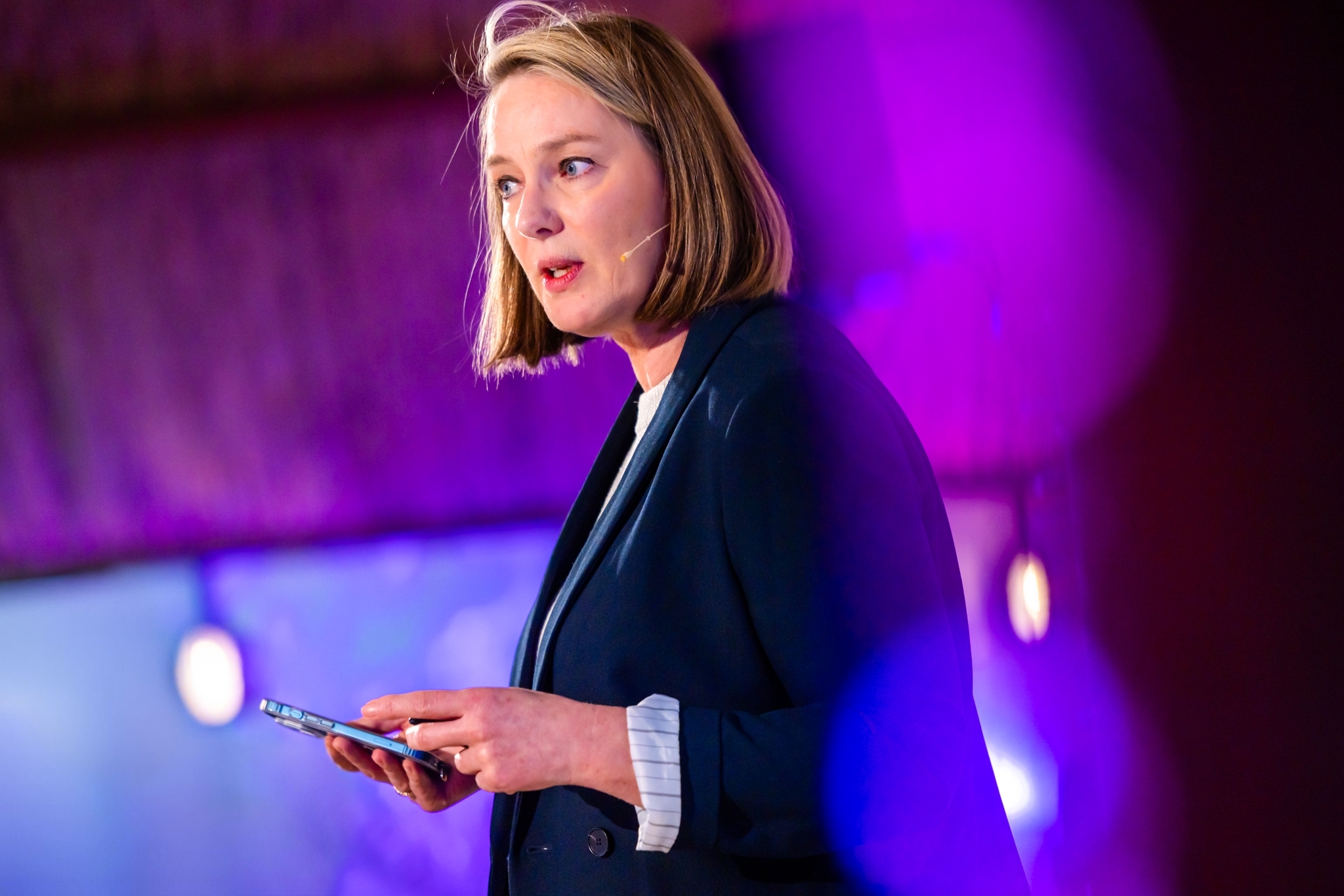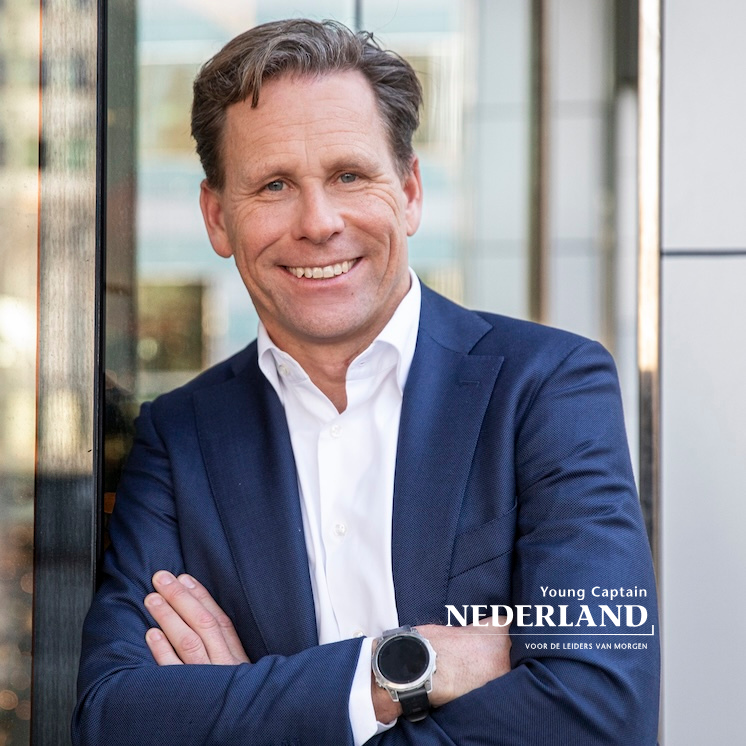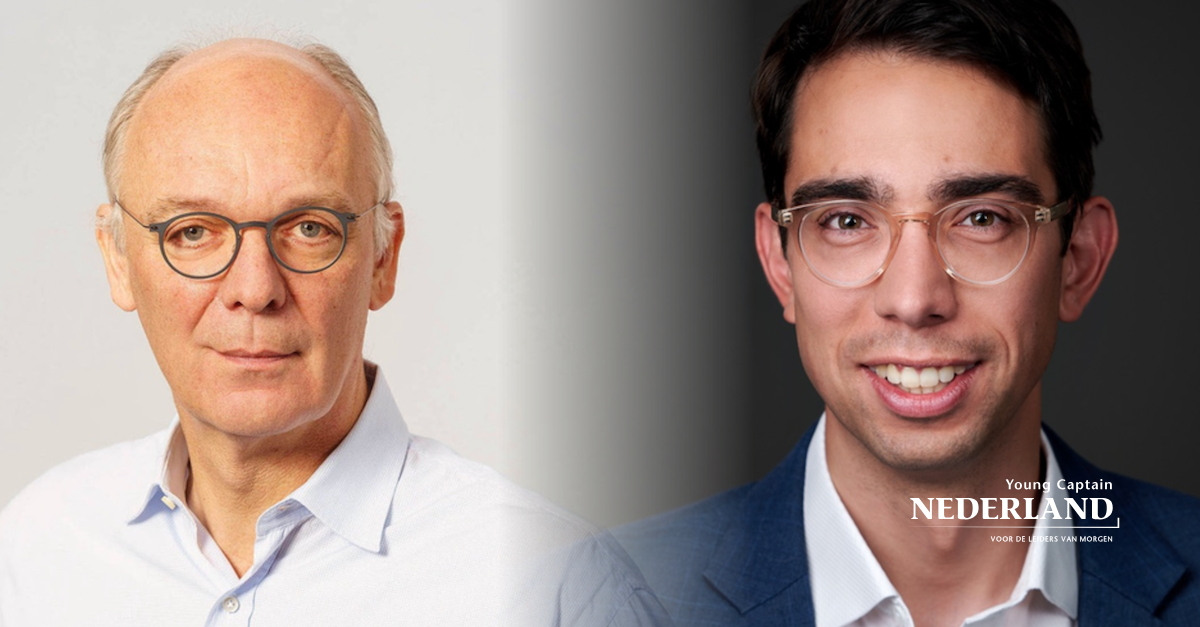
Two Award winners at different stages of their lives and careers: Hugo in his fifties, who is looking forward to new challenges after a career at Tata Steel, among others, and after selling his own company. And thirty-something George who develops every day at Philips and has most of his career ahead of him. The meeting between the two leads to an interesting conversation about the Young Captain process, about leadership, about soft skills and about business challenges.
From pioneer award to top platform
“When I participated in 2005, everything was still quite small and a bit of searching,” Hugo recalls. “At the time, there was not a single CEO of a listed company who attended the final. In George's year, I counted at least seven.”
For Hugo, the first ever Young Captain Award winner, it feels like a world of difference. “What started as an idea has grown in twenty years into an institution with stature and impact.” George nods in agreement, and he is also impressed by the professionalism of Young Captain Netherlands. “It was special to sit in front on that final night and experience everything intensely. Everything was tightly organized, I won't forget the experience anytime soon.”
Both praise the strength of the process, which they believe is the result of the level and tenacity of the people who have carried Young Captain for years. “One step better every year,” says Loudon. “Incremental improvement. That applies to the process, but also to leadership.” George adds: “I think what has been done is very impressive. Bill Gates said something nice about that: “Most people overestimate what they can do in one year and underestimate what they can do in ten years.”
A network that keeps giving
Hugo and George speak highly of the Young Captain network. “In my time, that network barely existed,” says Loudon. “Now I see how strong it has become. Alumni visit each other, help each other out.”
George is already experiencing that. “I learn from every conversation with former participants. You meet people you would never speak to otherwise. And there is an openness that you don't find in every business network.”
Both look back with pleasure on the special meetings that the Young Captain network has brought them. George laughs about how he sat next to former Prime Minister Jan Peter Balkenende at a lunch last year. “These are conversations that you don't just have anywhere else,” he says. “We talked about leadership and economics. And about — very surprisingly — Balkenende's observation that parking spaces in the Netherlands are sometimes so narrow.” Hugo remembers his own moment with Balkenende, still in office as prime minister at the time, at a dinner at Wittenburg Castle. “It was the night that Rita Verdonk founded 'Proud of the Netherlands'. You saw the political tension, and yet he took the time for an extensive conversation. You won't forget nights like that.”
Leadership changes over the years
Leadership is not a static concept; both fully agree on that. “I didn't have the peace I have now,” says Hugo. “My kids are out of the house, I'm reflecting more. And that changes your style.” George laughs. “I'm just in the middle of the hustle and bustle: young children, career, ambitions. But I am aware of the importance of that rest and reflection. I'm trying to make time for that.”
The difference in life phase does not provide a distance, rather understanding between Hugo and George. “You learn that not everything has to be solved immediately,” says Hugo. “I used to think: action! Now I think: listen first.” George: “I'm starting to discover that too. The biggest strength often lies in waiting a while and then doing the right thing.”
The rise of soft skills
Hugo and George agree on an important observation: between 2005 and now, there was a shift from hard to soft qualities. Loudon is firm: “The real development lies in soft skills, not hard skills. Knowledge is available everywhere. What matters is: can you listen? Connect?”
George: “It's only in crisis situations that you really notice. People don't need a leader who knows everything, but someone who exudes calm and is genuinely involved.”
Both call empathy crucial. Loudon: “If your team feels you understand what motivates them, they'll go through fire for you.” George: “Empathy isn't a luxury, it's a necessity.”
The power of rest
Rust is not a commonly discussed leadership quality, but it is an anchor point in this conversation. “And: unrest is contagious,” says George. “As a leader, you are the nervous system of the organization. If you're panicking, so are your people.”
Hugo: “Sure. Rest helps you to listen better and to judge more clearly. You don't have to respond to everything immediately.” He also highlights the importance of calm in technical environments. “I've always worked in complex companies where I wasn't a content expert myself. Then you have to listen, you have to trust others. And that starts with rest.”
Plea for broadening
Hugo and George speak with awe about what Young Captain has achieved in twenty years. But, they think, there is also work to be done. “Young Captain can become even wider,” says George. “Preferably through the participation of more people from new, fast-growing companies. The diversity in the type of organization really needs to increase.”
Loudon agrees. “Twenty years ago, companies were afraid they would lose their top talent if they participated. But that never happened. My plea: see Young Captain as an investment in your future.”
George: “Companies like Booking.com, Adyen — there's young leadership with a different context. We need to have those with us. Not just for the sake of inclusion, but also to make Young Captain himself even stronger.”
According to Hugo, the key is: actively invite. “Don't wait for them to come, but start talking. Why aren't they participating now? What do they need to participate?”
George: “That also results in cross-pollination. “Maybe companies like Adyen and Booking.com could be of value for the digital acceleration of more traditional companies. It is precisely the combination of different companies that makes this network unique.”
Today's leader
When the conversation comes to an end, Hugo and George draw conclusions. “Today's leader isn't the boss with the most knowledge or the loudest voice,” says George. “It's the one who listens, who keeps learning and who gives space to others.”
Hugo adds: “Leadership is not a trick. It's about who you are and what you express. Empathy, peace and curiosity — these are the pillars you build on.”
Both believe these qualities are timeless — and at the same time more urgent than ever. In a world that is becoming faster, more complex and polarizing, the human dimension is not a luxury, but a requirement.
Asking the right questions
Anything else to add, after all? Hugo: “For me, leadership has become less and less about answering questions and more about asking the right ones. That's where the future lies: daring to be in discomfort, not in the quick answer.”
George? “As a leader, you don't have to be able to do everything yourself, but you do need to know who to call if you don't know. It's about trust and giving direction.”
April 8
Today, the finalists of Young Captain Award 2025 (Kaya de Lange, Damla Hendriks, unfortunately Brian Broeders could not attend due to obligations elsewhere) traditionally received their media training from Hill & Knowlton (now Burson). One of the great privileges for Young Captain finalists.
At the same time, this moment also marked the farewell to our special collaboration with H&K, which has been a fruitful partnership since 2009. Together, we have achieved a lot and have always opted for strong, careful communication. Many thanks to everyone at H&K for your warm commitment and expertise. You really made a difference.
Everything comes to an end, and yes, that hurts a bit too. Fortunately, with Wepublic, we have found a new, enthusiastic partner who takes over. The 2026 finalists can therefore count on valuable and challenging media training from Wepublic.
Special thanks to Annika van Loenhout and Noelle Nijhof at Hill & Knowlton (Burson).
On the picture from left to right: Arjen van der Sar, Kaya the Long, Damla Hendriks, Rick Versteegh